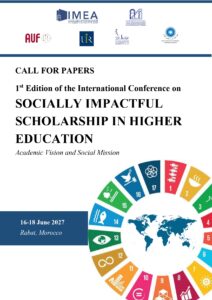
Call for Papers International Conference on

Socially Impactful Scholarship in Higher Education Academic Vision and Social Mission (1st Edition)

17-19 June 2027

 At a time when the boundaries between academia and society continue to shift, knowledge production must respond to broader social realities. In alignment with global frameworks such as the United Nations Sustainable Development Goals (SDGs) and the African Union’s Agenda 2063, this conference situates higher education within broader commitments to equity, sustainability, and inclusion. Universities can no longer operate as self-referential institutions where success is measured solely through publication metrics and citation counts. The question is not only whether research is rigorous, but whether it is consequential and capable of contributing to positive societal change.

The conference further recognizes that socially impactful scholarship must contribute to addressing major national and global challenges. At a time when societies face complex environmental, technological, economic, cultural, and social transformations, higher education and research institutions are increasingly called upon to generate knowledge that not only advances academic understanding but also contributes to public well-being, sustainable development, social justice, innovation, and evidence-informed decision-making. This commitment aligns with broader international efforts, including the United Nations Sustainable Development Goals (SDGs) and the African Union’s Agenda 2063, both of which recognize the central role of research and innovation in promoting sustainable, inclusive, and resilient societies.

Beyond the production and dissemination of knowledge, universities and research institutions are increasingly expected to serve as strategic actors in innovation, evidence-informed policymaking, sustainable development, and social transformation. This conference seeks to explore how scholarship can contribute meaningfully to addressing contemporary societal challenges while maintaining the highest standards of academic rigor, scientific integrity, and intellectual independence.

Objectives

  • Reposition social impact as a core dimension of scholarly value.
  • Examine how knowledge production engages with societal challenges, particularly in contexts marked by structural inequalities.
  • Foster dialogue across disciplines and sectors on the conditions that enable meaningful and responsible scholarship.
  • Support researchers in articulating the societal relevance of their work.
  • Promote dialogue on how research and innovation can contribute to addressing national, regional, and global challenges while advancing sustainable and inclusive development.

Scope and Participation

The conference welcomes contributions from all disciplines, including but not limited to:

  • Natural sciences and engineering
  • Social sciences and economics
  • Humanities and cultural studies
  • Education and teacher training
  • Law, governance, and public policy
  • Business and entrepreneurship
  • Artificial intelligence and data science
  • Environmental and sustainability studies
  • Arts, design, and creative practices
  • Applied linguistics and language policy

Submissions may adopt quantitative, qualitative, mixed, or theoretical approaches. Contributions from doctoral researchers and early-career scholars are particularly encouraged.

Thematic Areas

  • Education, Equity, and Empowerment
  • Open Education and Knowledge Access
  • Technologies, Ethics, and Social Futures
  • Artificial Intelligence and Social Responsibility
  • Public Health and Social Determinants
  • Economic Justice and the Future of Work
  • Policy, Governance, and Institutional Reform
  • Culture, Identity, Language, and Society
  • Intercultural Competence, Global Engagement, and Higher Education
  • Art and Social Transformation
  • STEM and Social Responsibility
  • Minority Languages and Cultural Preservation
  • Heritage Languages, Transmission, and Intergenerational Continuity
  • Human Rights, Social Inclusion, and Equity
  • Interdisciplinarity for Sustainable Development
  • Research, Innovation, and Societal Impact in Addressing National and Global Challenges
  • Open Research and the Politics of Knowledge
  • Higher Education Reform and Accountability
  • Water security, climate resilience, and environmental sustainability
  • Food security, sustainable agriculture, and rural development
  • Renewable energy, green hydrogen, and energy transition
  • Health, biotechnology, and wellbeing
  • Artificial intelligence, digital transformation, and educational technologies
  • Innovation ecosystems, entrepreneurship, and technology transfer
  • Governance, public policy, and social inclusion
  • Cultural heritage, linguistic diversity, and social cohesion
  • Sustainable cities, territorial development, and resource management

Core Question

All submissions should clearly address the following question: How does this research serve society?

Submission Categories

To encourage diverse forms of scholarly engagement and knowledge exchange, the conference offers several submission formats. Authors and participants are invited to select the format that best suits the nature of their contribution.

Submissions are invited under the following categories:

  1. Individual Paper Presentations – for original research papers, theoretical contributions, policy analyses, or case studies.
  2. Thematic Panel Sessions – for coordinated discussions bringing together multiple speakers around a common theme. Session should consist of one Chair/Convenor and three to four panelists.
  3. Poster Presentations – for the presentation of research projects, work in progress, methodological innovations, or practice-based initiatives.

Please consult the guidelines below for the specific submission requirements applicable to each category.

1. Individual Paper Presentations

The conference welcomes proposals for Individual Paper Presentations that address the conference theme and one or more of its thematic areas. Contributions should present original research, theoretical analyses, methodological innovations, policy perspectives, or examples of impactful practice that advance knowledge and contribute to addressing contemporary societal challenges.

Submissions from researchers, doctoral candidates, practitioners, policymakers, professionals, and representatives of civil society are welcome. Interdisciplinary, comparative, and collaborative contributions are particularly encouraged.

Presentation Format

Accepted papers will be organized into thematic parallel sessions.

Each presentation will consist of:

  • 15 minutes for the presentation;
  • 20 minutes for discussion and questions at the end of the panel.

Presenters are expected to focus on the key aspects of their work, including the research problem, objectives, methodology, principal findings, implications, and contribution to scholarship and society.

Abstract Submission

Authors should submit via the “Submit abstract for Individual Paper Presentation sessions

  • Title of the paper: Abstract titles should be concise (No more than 15 words) and clearly reflect the focus of the research
  • Theme Selection: Indicate the conference theme under which the submission should be considered
  • Author Details: Provide full names (surname, first name) and institutional affiliations for all authors and email address(es);
  • Language: Submissions can be in English, Arabic and French
  • Format: Single abstract per submission (no merged papers unless part of a panel proposal)
  • Abstract should of 300–500 words, clearly outlining:
    • the research problem or topic;
    • objectives of the study;
    • theoretical or conceptual framework (where applicable);
    • methodology;
    • principal findings or expected outcomes;
    • significance and contribution to the conference theme;
    • Three to five keywords;
  • A short biography (100–150 words) for each author.

Evaluation Criteria

Abstracts will be evaluated according to the following criteria:

  • Relevance to the conference theme and thematic areas;
  • Originality and significance of the proposed contribution;
  • Clarity of objectives and research questions;
  • Methodological rigor and coherence;
  • Quality of analysis and scholarly contribution;
  • Potential societal impact and relevance;
  • Overall quality of writing and organization.

Accepted papers will be grouped into thematic sessions designed to promote interdisciplinary dialogue, constructive feedback, and scholarly exchange.

2. Thematic Panel Sessions

In addition to individual paper presentations, the conference welcomes proposals for Thematic Panel Sessions that foster interdisciplinary dialogue and collaborative reflection on issues related to the conference theme. Panels provide an opportunity to examine complex challenges from multiple perspectives and to promote meaningful exchange among researchers, practitioners, policymakers, and other stakeholders.

Panels should address a clearly defined topic or contemporary issue of broad relevance to the conference and encourage critical discussion, interdisciplinary dialogue, and audience engagement.

The conference particularly welcomes panels that bring together researchers, policymakers, community organizations, industry representatives, NGOs, international organizations, and other societal partners, reflecting its commitment to socially impactful scholarship, interdisciplinary collaboration, and the co-production of knowledge.

Panel Format

Each panel will normally consist of:

  • One Panel Chair/Convenor, who will coordinate the proposal and moderate the session;
  • Three to four panellists representing different disciplines, institutions, sectors, or countries;
  • A 90-minute session, including presentations, moderated discussion, and audience participation.

Panels may include academics as well as practitioners, policymakers, representatives of civil society, industry, governmental and non-governmental organizations, and community partners, where appropriate.

Panel Proposal Submission

The Panel Chair should submit a single proposal on behalf of all participants, via the “Submit abstract for Thematic Panel sessions“, including:

  • Panel title;
  • Name, institutional affiliation, and contact details of the Panel Chair;
  • Names, affiliations, and email addresses of all panelists;
  • A panel abstract (400–600 words) outlining:
    • the theme and objectives of the panel;
    • its relevance to the conference theme;
    • the main issues or questions to be addressed;
    • the contribution of each panelist and the overall coherence of the panel;
  • A 100–150-word biography for each panel participant.

In addition to the panel proposal, each panelist is required to submit an individual abstract via the “Submit Abstract for Thematic Panel Sessions” link. Abstracts should follow the guidelines for Individual Paper Presentations and include the title of the corresponding panel.

Evaluation Criteria:

Panel proposals will be evaluated according to the following criteria:

  • Relevance to the conference theme and thematic areas;
  • Originality, significance, and timeliness of the proposed topic;
  • Coherence and complementarity of the proposed contributions;
  • Diversity of disciplinary, institutional, geographical, and professional perspectives;
  • Potential to generate meaningful discussion and audience engagement;
  • Contribution to advancing socially impactful scholarship.

Accepted panels will be included in the conference programme as interactive sessions designed to stimulate dialogue, encourage interdisciplinary exchange, and strengthen collaboration between academia and society.

3. Poster Sessions

The conference will include a dedicated Poster Session featuring up to 20 poster presentations. Posters may present completed research, work in progress, methodological innovations, community-engaged projects, or doctoral research.

Printed posters will be exhibited in the conference lobby and arranged according to the designated spaces listed in the official program.

Poster proposal submission:

Each presenter must submit their proposal via the “Submit abstract for Poster sessions

Submissions must include:

  • A title (maximum 15 words maximum)
  • The name of at least one responsible author
  • An abstract (maximum 250-300 words) that includes:
  • Study background
  • Research questions
  • Theoretical framework or conceptual approach
  • Methodology (methods and data sources)
  • Main findings
  • 3 to 5 keywords
  • A list of 2 to 4 references

4. Pre-Conference Doctoral Workshops

As part of its commitment to supporting junior researchers, the conference will offer a series of Pre-Conference Doctoral Workshops designed to strengthen doctoral researchers’ academic, research, and professional competencies while fostering socially impactful scholarship.

The workshops will provide doctoral candidates with practical knowledge, methodological guidance, and opportunities to engage with experienced scholars, journal editors, policymakers, and practitioners. They are intended to complement the conference program by equipping participants with the knowledge and skills needed to conduct rigorous, ethical, and socially relevant research.

Participation in the workshops is open to doctoral researchers from all disciplines. As places are limited, interested participants must apply through the “Apply for the Pre-Conference Program” option. Applications will be reviewed by the Organizing Committee, and selected applicants will be notified in due course.

Indicative Workshop Themes

The pre-conference programme will focus on strengthening doctoral researchers’ capacity to design, conduct, and communicate socially impactful research. The program may include workshops on topics such as:

  • Designing Research for Societal Impact
  • Research Design, Methodology, and Responsible Research
  • Artificial Intelligence for Responsible and Ethical Research
  • Open Science, Open Data, and Research Integrity
  • Knowledge Mobilization, Public Engagement, and Policy Impact
  • Academic Writing, Publishing, and Research Funding

Additional workshops may be offered based on participant interest and the availability of facilitators.

Registration

Doctoral researchers wishing to participate in the Pre-Conference Doctoral Workshops must submit an application through the Apply for the Pre-Conference Program option on the conference submission platform.

As places are limited, applications will be reviewed by the Organizing Committee. Selection will be based on the relevance of the applicant’s profile and motivation, while ensuring disciplinary, institutional, and geographical diversity.

Successful applicants will be notified prior to the conference.

Important Dates

  • Call launch: 20 June 2026
  • Abstract submission deadline: September 30, 2026
  • Notification of acceptance: October 30, 2026
  • Conference Dates: 17-19 June 2027
  • Pre-Conference Doctoral Workshops: 16 June 2027.

Registration Fees

  • International Researchers: 3000 MAD (€300)
  • Moroccan Researchers: 1000 MAD
  • Doctoral Researchers: 500 MAD

The conference offers authors the opportunity to extend the reach of their work. A selection of the most original and high-quality papers will be invited for publication in a high-impact international journal, following a rigorous peer-review process, with particular attention to contributions that combine strong academic grounding and clear societal relevance.

For further information, please contact: